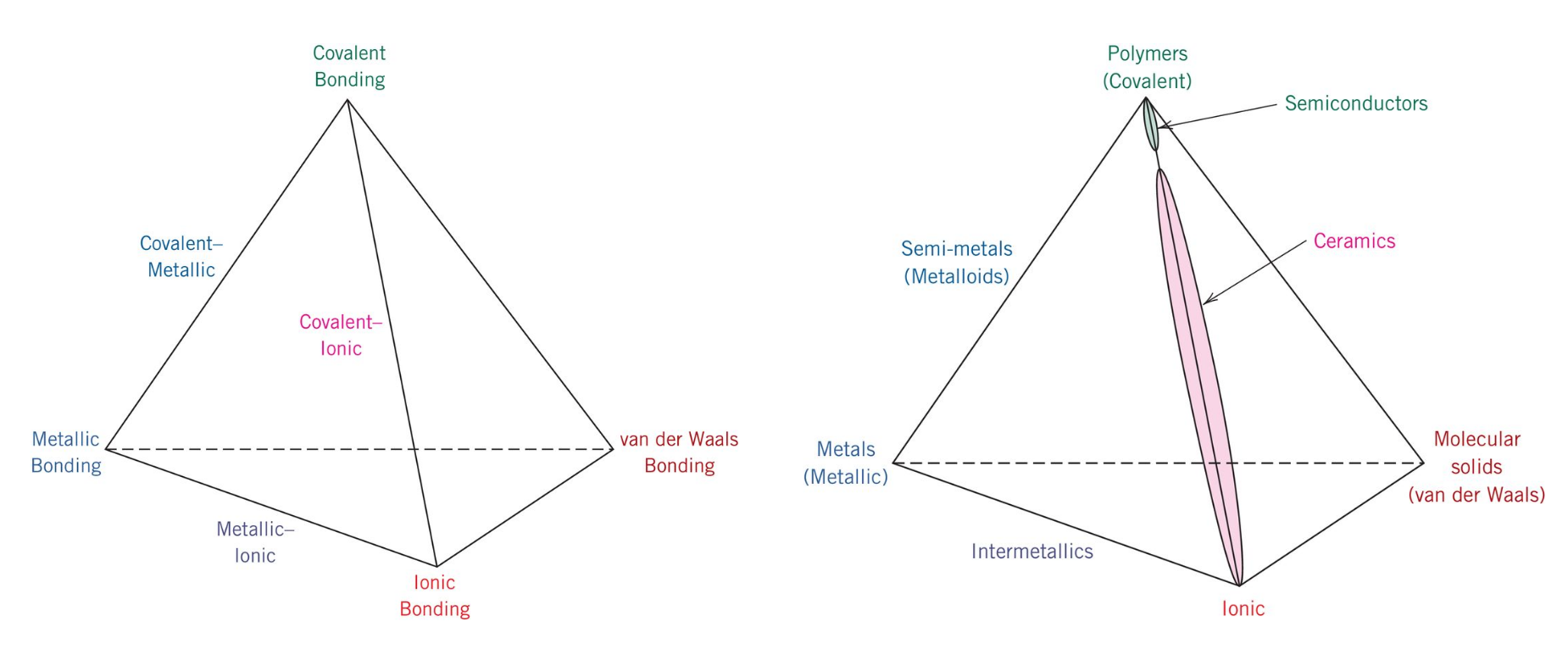
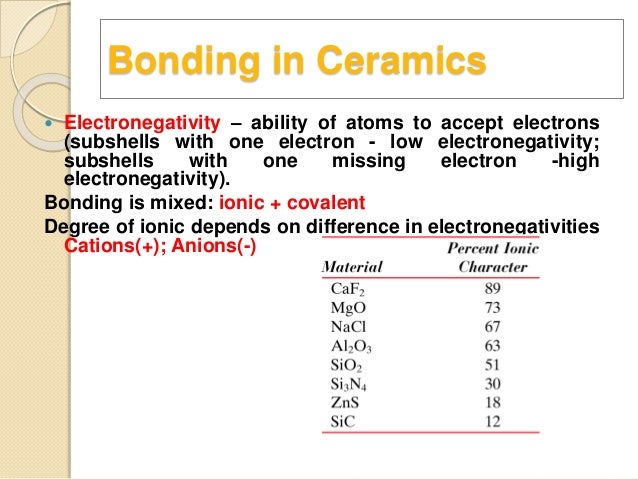
Although both types of bonds occur between atoms in ceramic materials in most of them particularly the oxides the ionic bond is predominant.
Covalent bond ceramic.
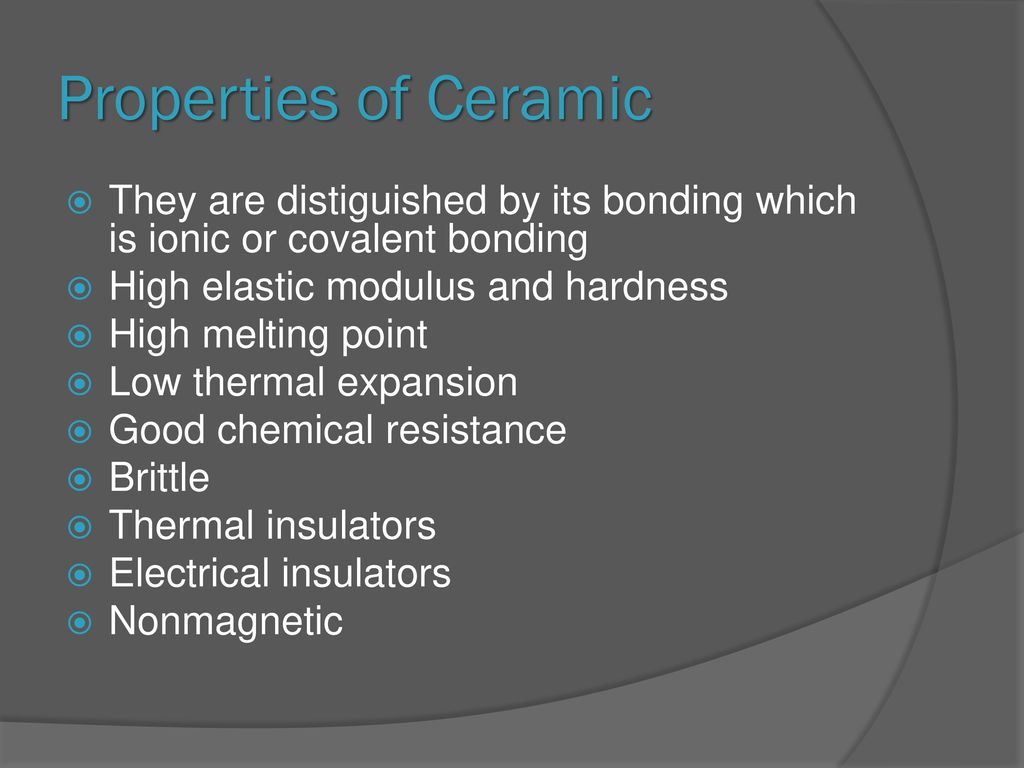
A material held together by either type of bond will tend to fracture before any plastic deformation takes place which results in poor toughness in these materials.
Advanced ceramics advanced ceramics chemical bonding.
Compounds with covalent bonds may be solid liquid or gas at room temperature depending on the number of atoms in the compound.
This electron transfer creates positive metal ions cations and negative nonmetal ions anions which are attracted to each other through coulombic attraction.
Covalent bonding is found in many ceramic structures such as sic bn and diamond.
The more atoms in each molecule the higher a compound s melting and boiling temperature will be.
So if two identical nonmetals e g two hydrogen atoms bond together they will form a pure covalent bond.
The high energy of covalent bonds makes these ceramics very stable with regard to chemical and thermal.
Reaction sintering or reaction bonding is an important means of producing dense covalent ceramics.
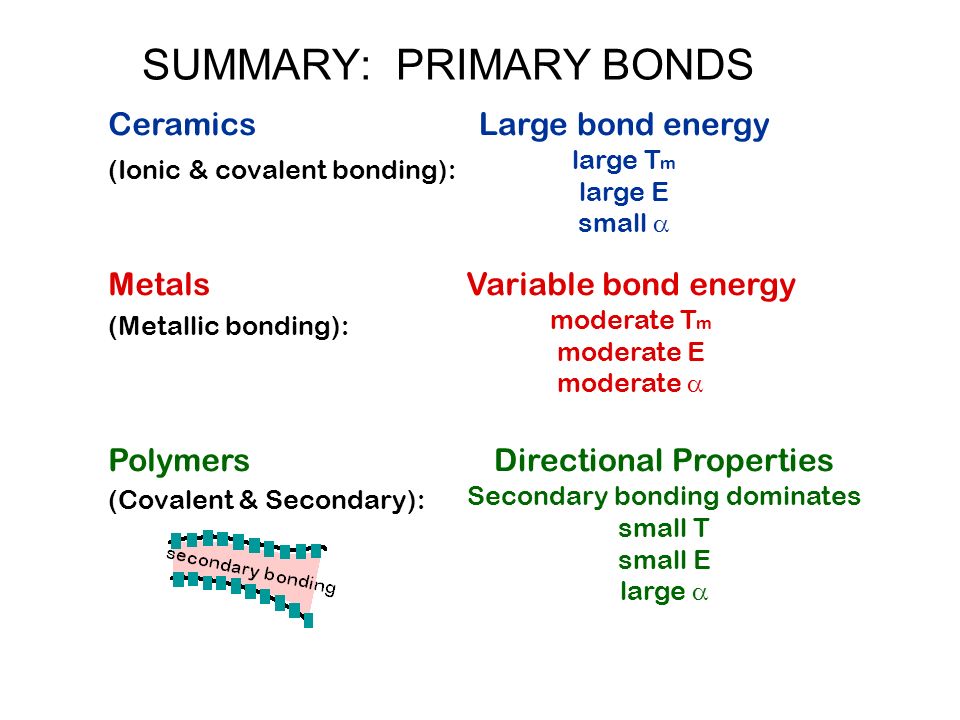
Underlying many of the properties found in ceramics are the strong primary bonds that hold the atoms together and form the ceramic material.
Many ceramic materials have covalent bonds.
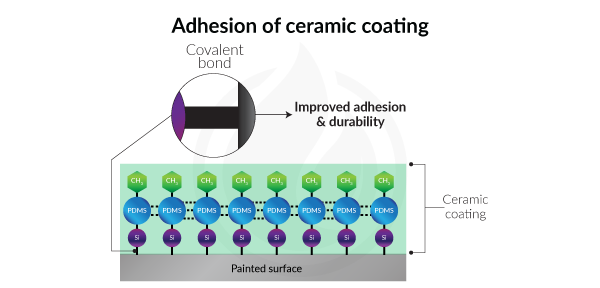
Having started as a hobby today we lead the innovation in ceramic coating nanotechnology.
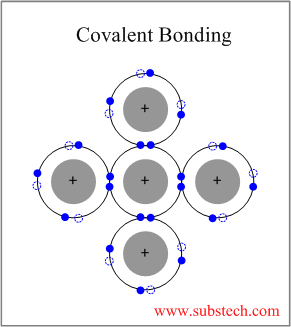
Covalent bonding instead occurs between two nonmetals in other words two atoms that have similar electronegativity and involves the sharing of electron pairs between the two atoms.
They are either ionic in character involving a transfer of bonding electrons from electropositive atoms to electronegative atoms or they are covalent in character.
Since most covalent compounds contain only a few atoms and the forces.
Reaction bonded silicon nitride rbsn is made from finely divided silicon powders that are formed to shape and subsequently reacted in a mixed nitrogen hydrogen or nitrogen helium atmosphere at 1 200 to 1 250 c 2 200 to 2 300 f.
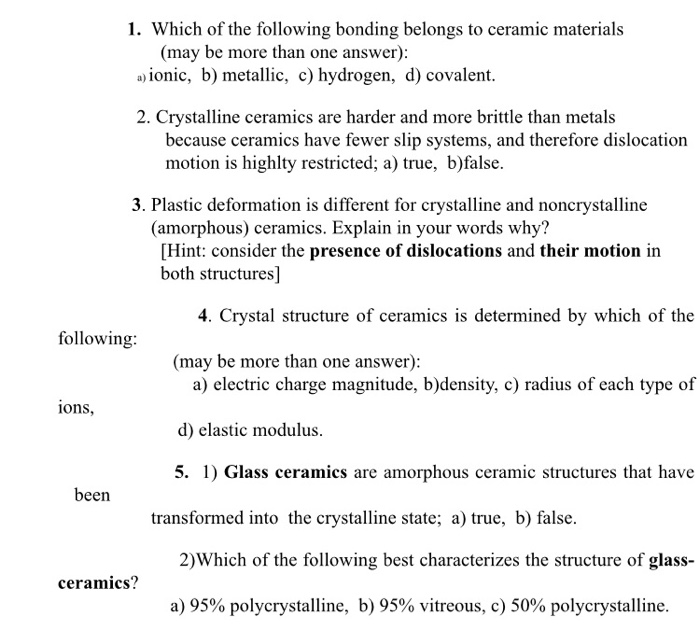
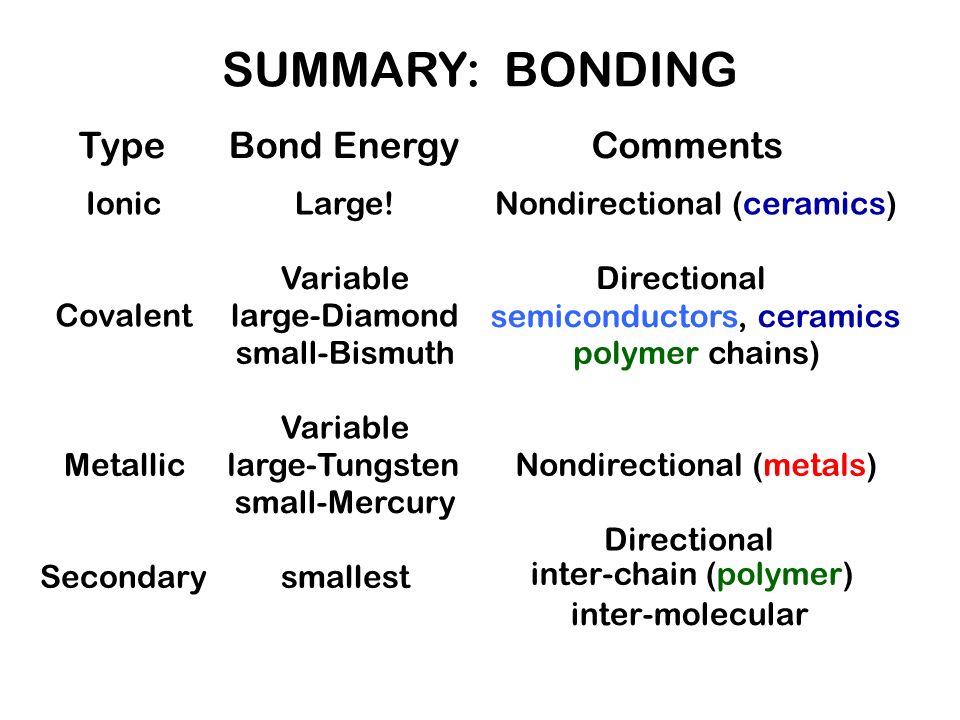
The two most common chemical bonds for ceramic materials are covalent and ionic.
Kovalent coatings journey has been one involving great dedication for quality.
The bonding of atoms together is much stronger in covalent and ionic bonding than in metallic.
Ceramic materials are usually ionic or covalent bonded materials and can be crystalline or amorphous.
Recall that the predominant bonding for ceramic materials is ionic bonding.
The atoms in ceramic materials are held together by a chemical bond.
Covalent bonds form when two nonmetallic atoms have the same or similar electronegativity values.
In ionic bonding a metal atom donates electrons and a nonmetal atom accepts electrons.
The atoms in these ceramics are arranged so that each pair of nearest neighbour atoms forms a chemical bond by sharing a pair of electrons.
These chemical bonds are of two types.
What determines whether a covalent bond forms.
When two dissimilar nonmetals form bonds e g hydrogen and oxygen they will form a covalent bond but the electrons will spend more time.